
Loading Viewer…
A four‑year‑old girl sits on a kitchen floor. In front of her: a broken toaster, a butter knife, and a flashlight. Her mother walks in, sighs, and says: “Stop playing with that. You’ll break it.”
The girl looks up. “It’s already broken, Mommy. I’m fixing it.”
That child has no MBA, no performance review, no fear of looking stupid. She has something more powerful: curiosity without shame.
Now imagine that same girl, twenty years later. Same broken toaster. Same tools. But now she freezes. “I don’t know how to fix this. I should call someone. What if I make it worse?”
What happened?
Somewhere between finger‑paint and spreadsheets, we unlearned how to solve problems. We traded curiosity for caution. Experimentation for expertise. Play for panic.
And that, right there, is the single biggest reason why most adults are terrible problem solvers.
The Ugly Truth (The Problem Statement)
Let’s run a quick experiment.
Think of the last three problems you faced at work or home.
Did you actually solve them? Or did you just manage them until they became less urgent?
If you’re like 92% of professionals in a Harvard Business Review study, you didn’t solve the problem. You coped with it. And coping is not solving.
Here’s the data that hurts:
- Adults given a simple logic puzzle will use a complicated method 80% of the time—even when a simple method exists—because their brains are stuck in learned routines.
- Children aged 4–6 outperform adults on novel solutions by a factor of 3 to 1.
Let that sink in.
A preschooler is a better novel problem solver than a corporate manager.
The reason isn’t intelligence. It’s mindset.
The Hidden Trap (Why You’re Stuck)
Most adults operate in rigid thinking mode:
- “There’s one right way.”
- “I need certainty before I act.”
- “If I’m wrong, I look stupid.”
Children operate in fluid thinking mode:
- “Let’s try five ways.”
- “I’m comfortable with not knowing.”
- “What happens if I do this?”
The painful truth: you weren’t born rigid. You were trained rigid. By school exams with one correct answer. By bosses who punished mistakes. By a culture that celebrates “knowing” and shames “wondering.”
The good news?
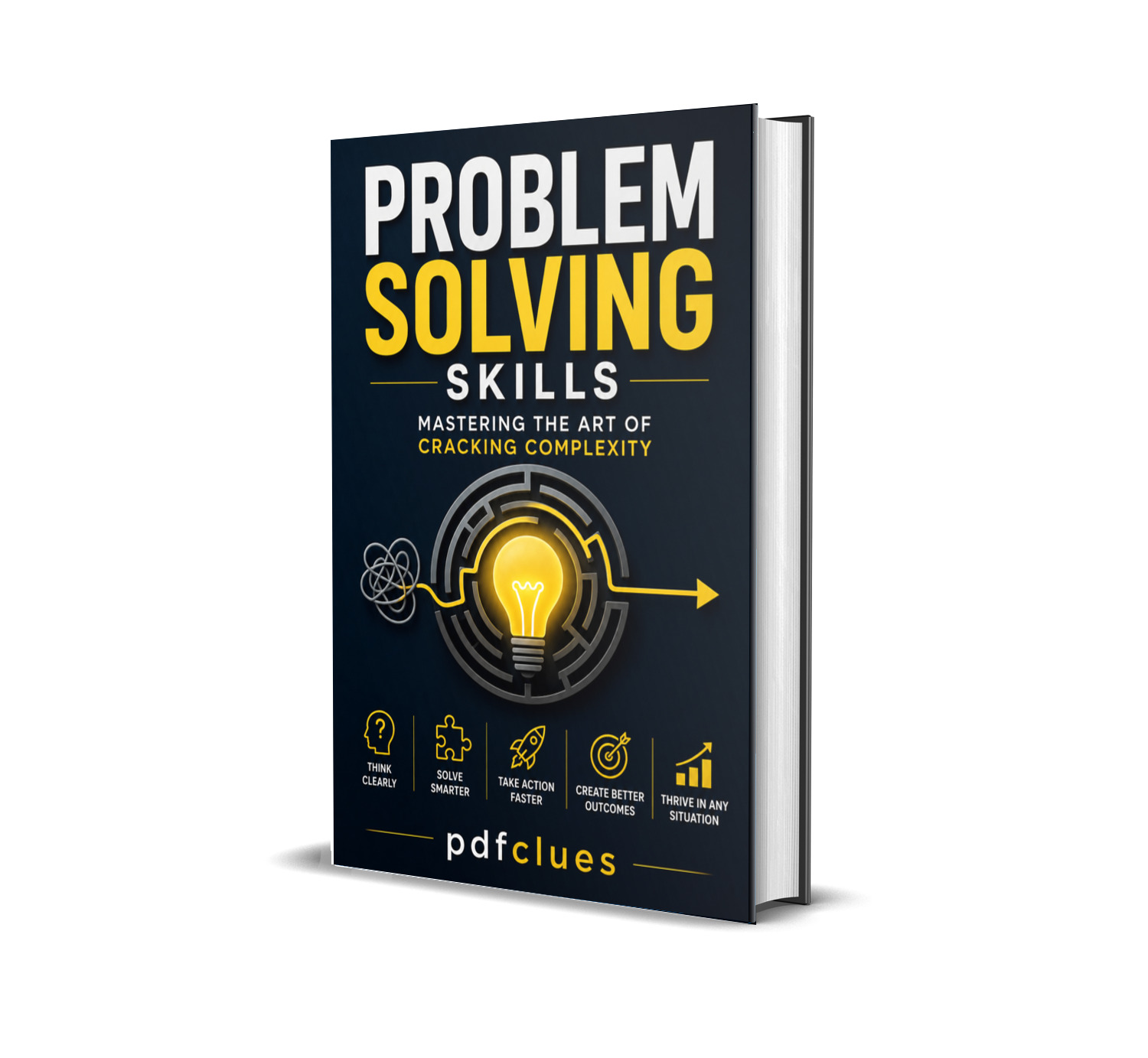
You can unlearn rigidity. And that’s exactly what a new book—Problem Solving Skills: Mastering the Art of Cracking Complexity—is designed to help you do.
The Big Shift (What Actually Works)
After years of studying how the world’s best problem solvers think—from NASA engineers to startup founders to ER nurses—one pattern emerges.
They don’t have more IQ points. They have a different operating system.
Here are four switches you can flip today:
| Old Mindset | New Mindset |
|---|---|
| “Who caused this?” | “What’s really happening?” |
| “I need to be right.” | “I need to learn.” |
| “This is a disaster.” | “This is an interesting puzzle.” |
| “Problems are exhausting.” | “Problems are invitations.” |
The most powerful shift?
From blame to ownership.
Blame feels good for three seconds. Then it paralyzes you.
Ownership feels uncomfortable at first. Then it frees you—because ownership always comes with leverage.
Try this right now: Think of a problem you’ve been complaining about for weeks. Rewrite it as an ownership statement starting with: “What I can influence here is…”
Feel that shift? That’s the first step.
The Tool You’ve Never Heard Of (But Will Use Forever)
In the book, one tool alone saves teams hundreds of hours. It’s called the Problem Statement Canvas.
Most people jump to solutions before they define the problem. That’s like building a bridge to the wrong shore.
The Canvas forces you to answer seven questions before you do anything:
- What’s the observable symptom? (No blame, no interpretation.)
- Who is impacted, how badly, and how often?
- Where does this problem NOT happen? (This is the question everyone skips.)
- What are three possible root causes (not yet verified)?
- Who has the authority and ability to influence this?
- How will you know the problem is truly solved?
- Can you write a one‑line problem statement that a smart seven‑year‑old would understand?
Here’s the magic: when you force yourself to answer these, you often realize halfway through that your initial “obvious solution” was aimed at a symptom, not the root.
A hospital used this tool and discovered their ER wait times weren’t caused by a shortage of doctors—they were caused by a 12‑page intake form that nobody had questioned in a decade. They changed the form. Wait times dropped 37%. Cost: zero dollars.
What The Book Gives You (The 10‑Chapter Promise)
Problem Solving Skills: Mastering the Art of Cracking Complexity is not a fluffy “think positive” book. It’s a field manual. Each chapter gives you a tool you can use before lunch.
- Chapter 1 rewires your reflexes—from panic to playful curiosity.
- Chapter 2 saves you from the #1 mistake: solving the wrong problem.
- Chapter 3 exposes hidden biases (confirmation bias, functional fixedness) that secretly run your decisions.
- Chapter 4 unlocks creativity—even if you think you’re “not the creative type.”
- Chapter 5 gives you a cheat sheet: which tool for which mess (simple, complicated, complex, or chaotic).
- Chapter 6 turns you into a system detective—finding the tiny lever that moves mountains.
- Chapter 7 transforms failure from shame into your smartest teacher (including a “Failure Resume” template).
- Chapter 8 fixes broken team dynamics—no more silent disagreements or loud egos.
- Chapter 9 gets you from whiteboard to real world fast (no perfection paralysis).
- Chapter 10 makes problem solving an infinite game—resilient, adaptive, even fun.
By the end, you won’t just solve problems. You’ll smell them coming.
Who This Book Is For (Probably You)
- The overwhelmed manager tired of firefighting the same crises.
- The ambitious professional who wants to stand out by fixing what others avoid.
- The entrepreneur drowning in unexpected obstacles.
- The student or recent grad who realizes exams never taught real‑life thinking.
- Any human being who is secretly exhausted by feeling “stuck.”
Even if you’ve never considered yourself a “problem solver.” Even if your last attempt failed spectacularly. Especially then.
The Hidden Cost of Not Reading This Book
Every problem you avoid, delay, or mishandle carries a tax.
It’s the tax of lost time. Of repeated arguments. Of sleepless nights. Of solutions that work today but explode tomorrow.
That tax is far higher than the price of a book.
A Final Provocation (Read This Twice)
“The quality of your life is the quality of the problems you’re willing to solve.”
— Adapted from Paul Graham
Most people spend their energy tolerating problems instead of cracking them. They adapt. They cope. They numb.
This book is an invitation to do the opposite: to step toward the knot, untie it with delight, and teach others to do the same.
You don’t need more intelligence. You need more structure, creativity, and nerve.
Ready to Crack Complexity?
The first chapter is waiting. And so is that four‑year‑old girl inside you.
She still knows how to fix things. She’s just been waiting for you to let her back into the room.
Get the book:
Problem Solving Skills: Mastering the Art of Cracking Complexity
Available now at pdfclues books — knowledge you can use.
FAQS up on the ‘Problem Solving Skills’
Is this book only for business professionals?
Not at all. While the examples include business scenarios (meetings, projects, strategy), the tools work for any problem—personal, relational, financial, or creative. The hospital ER example is healthcare. The toaster story is everyday life. The Failure Resume (Chapter 7) has been used by entrepreneurs, artists, and even parents. Problems are universal. So are the solutions.
I’m not a “creative person.” Will Chapter 4 still work for me?
Yes—and that chapter was written specifically for you. Creativity is not a personality trait; it’s a process. Chapter 4 teaches tools like SCAMPER and Reverse Brainstorming that force creativity even when you don’t “feel” creative. In fact, people who claim they’re not creative often generate the most surprising ideas because they have fewer ego attachments to being “original.” Try the 50‑Idea Challenge. You’ll surprise yourself.
How is this book different from other problem‑solving books?
Most problem‑solving books fall into three traps:
Fluff (“just think positive”).
Academic density (unreadable theory).
One‑tool wonder (here’s a fishbone diagram, good luck).
This book gives you a complete toolkit (10 chapters, 20+ tools) but teaches them through stories, case studies, and one‑page summaries. It also addresses why your brain sabotages you (biases, groupthink, sunk cost) before teaching what to do. And it includes a “Cracking Map” at the end of each chapter—a one‑page visual summary you can actually use.I work alone (freelancer, solo entrepreneur). Is the team chapter relevant?
Partially. Chapter 8 (The Collaboration Code) focuses on team dynamics, but many tools work for solo problem solvers:
Six Thinking Hats can be worn by one person (just switch hats sequentially).
Quiet Brainwriting becomes “silent self‑brainstorming.”
Disagree‑and‑Commit helps you commit to your own decisions after honest self‑debate.
If you truly never work with anyone, you can skim Chapter 8. But most solo workers still collaborate with clients, vendors, or family members—and the psychological safety principles apply there too.How long does it take to read and apply the book?
Reading time: 4–6 hours for all 10 chapters (each chapter is ~2,500–3,000 words).
Application time: Each chapter includes a “24‑hour challenge” that takes 5–30 minutes.
The book is designed to be read in a weekend and used for a lifetime. Many readers finish one chapter, do the challenge, then put the book down for a day. That’s perfect. Slow application beats fast consumption.What if I try the Problem Statement Canvas and still can’t define the problem?
That’s actually a sign of progress—not failure. If you can’t fill out the Canvas, it means you’re in “Disorder” (Chapter 5’s Cynefin framework). The solution is not to force it. Instead:
Go observe the problem for 2 hours without trying to solve it.
Interview someone affected by it.
Ask the “Fuzzy Situation Filter” questions (Chapter 2).
The Canvas is a diagnostic tool. If it’s not working, the diagnosis is “not enough data.” Go get more data. Then return to the Canvas.I’ve tried “brainstorming” before and it failed. Why is Chapter 4 different?
Traditional brainstorming fails for three reasons:
Loud voices dominate (solution: Quiet Brainwriting).
People mix criticism with creation (solution: separate divergent and convergent phases).
Groups stop after 5–10 ideas (solution: the 50‑Idea Challenge).
Chapter 4 fixes all three. It also adds forced associations, SCAMPER, and reverse brainstorming—tools that force novelty instead of hoping for it. If your past brainstorming failed, it wasn’t because brainstorming is broken. It’s because you were using a broken version.Does the book cover how to handle office politics or difficult people?
Indirectly, yes. Chapter 8 (Collaboration Code) addresses psychological safety, meeting hijacks, and silent disagreement. Chapter 3 (cognitive biases) helps you recognize when your own perceptions are distorted by fear or ego. Chapter 7 (failure learning) includes blame‑free post‑mortems.
However, the book is not a dedicated “office politics” manual. It assumes good faith among team members. If you’re dealing with truly toxic or malicious behavior, you may need additional resources. But for normal difficult people—the ones who interrupt, dominate, or avoid decisions—the structured tools (Six Thinking Hats, Disagree‑and‑Commit, anonymous voting) work remarkably well.What’s the single most important thing I can do after reading the blog article?
The 24‑hour challenge from the blog (and Chapter 1):
Pick one small problem from your life right now—a messy drawer, a slow email thread, a repeated annoyance.
Do not solve it. Instead, spend 10 minutes asking “why” like a child. Write down every question. Then notice how you feel afterward.
That single act—replacing panic with curiosity—is the foundation for everything else. Do that today. Then consider the book for the rest.Where can I buy the book? Is there a sample chapter?
The book Problem Solving Skills: Mastering the Art of Cracking Complexity is available at pdfclues books in high‑quality PDF format (readable on any device, printable, searchable).
Sample chapter: Chapter 1 (“The Curiosity Spark”) is available as a free preview on the pdfclues product page. It includes the full toaster story, the mindset shift table, and your first 24‑hour challenge.